
Introduction
Every year, as the rains arrive and the air turns damp, many homes in Perambur, Kolathur, Villivakkam and Otteri see the same thing: one child wakes up with a red, sticky eye, and within days others in the family have it too. This is what most people in Chennai call Madras eye. The medical name is conjunctivitis.
Madras eye is usually mild and settles on its own, but it spreads very easily, and a few cases need an eye doctor’s attention. This article explains the symptoms, how long it lasts, how long you can spread it, whether you can go to work or school, and when you should not wait.
Quick answer: what is Madras eye?
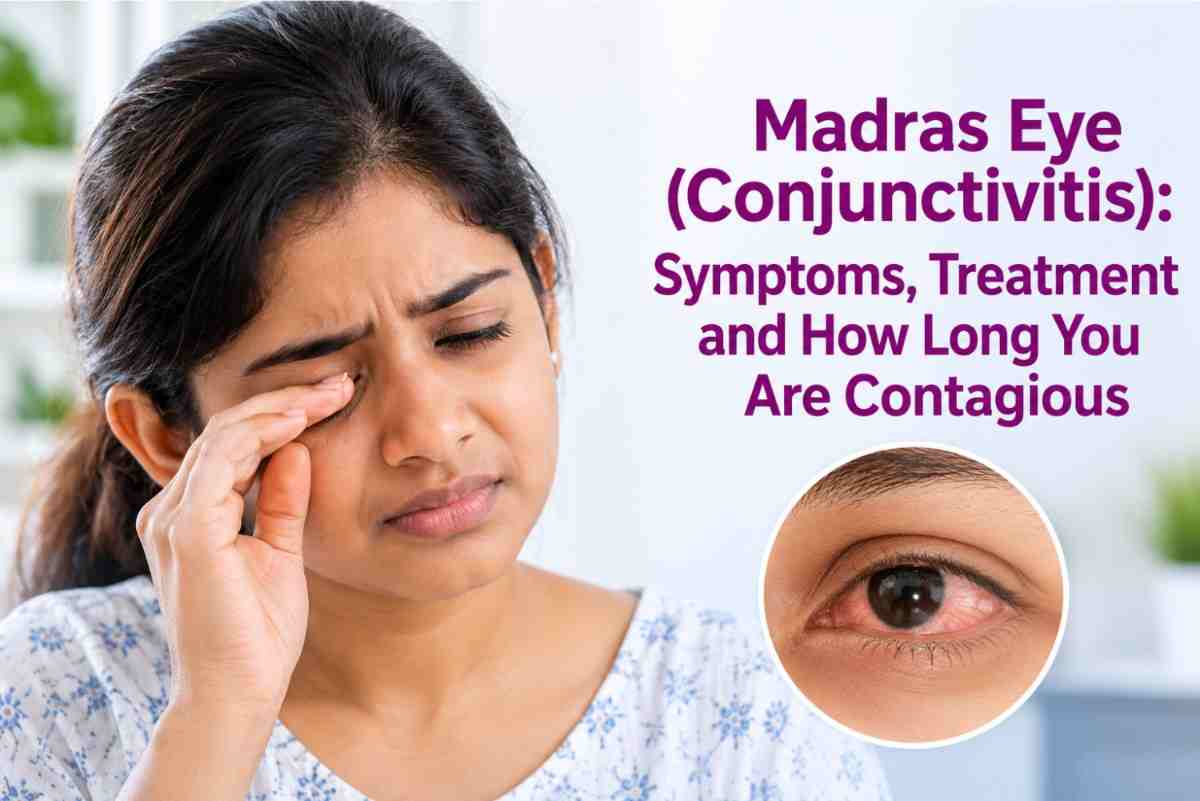
Madras eye is the common name for conjunctivitis, an inflammation of the conjunctiva. The conjunctiva is the thin, clear layer that covers the white of the eye and lines the inside of the eyelids. When it is inflamed, the eye turns red, feels gritty and waters or produces discharge. Most cases are caused by a virus, some by bacteria, and some by allergy. Viral and bacterial types are contagious. Allergic conjunctivitis is not.
Madras eye symptoms
Common signs include:
- Redness in one or both eyes
- Watering, or a sticky discharge, especially on waking
- Eyelids stuck together in the morning
- A gritty or burning feeling, as if sand is in the eye
- Itching
- Swollen eyelids
- Mild sensitivity to light
- Sometimes a sore throat, cold or fever along with the eye symptoms, in viral cases
It often starts in one eye and reaches the other within a day or two.
Red eye causes: not every red eye is Madras eye
A red eye has many causes, and some are more serious than conjunctivitis. The common ones are:
- Viral conjunctivitis: The most common type. Usually watery discharge, and often follows a cold. Highly contagious.
- Bacterial conjunctivitis: Thicker yellow or green discharge that keeps returning and glues the eyelids together.
- Allergic conjunctivitis: Intense itching and watering, often with sneezing or a runny nose. Both eyes are usually affected and it is not contagious.
- Irritation: From smoke, dust, chlorinated water or rubbing the eyes.
- Dry eyes and eye strain: From long screen hours, fans or air conditioning.
- More serious conditions: Such as corneal infection or ulcer, uveitis (inflammation inside the eye) and glaucoma. These can threaten vision and need prompt care.
This is why a red eye that is painful or affects vision should not be treated as Madras eye without an examination.
How does Madras eye spread?
The infection spreads through contact with eye secretions. Common ways include:
- Touching an infected eye and then touching other people, doorknobs, phones or shared objects
- Sharing towels, handkerchiefs, pillows, spectacles, eye drops or eye make-up
- Rubbing the eyes with unwashed hands
- Close contact in crowded places such as schools, hostels and offices
- Coughing and sneezing in viral cases that come with a cold
A common belief is that looking into the eyes of a person with Madras eye spreads the infection. This is a myth. The germs spread through touch and shared items, not through eye contact.
How long are you contagious?
This is the question most families ask. In general:
- Viral conjunctivitis remains contagious as long as the eyes are red and watering, often for the first several days, and sometimes for around a week or a little longer.
- Bacterial conjunctivitis remains contagious while there is discharge. It becomes much less contagious soon after proper antibiotic treatment begins, though your doctor will advise on this.
- Allergic conjunctivitis is not contagious.
A practical rule is that a person is most infectious while the eyes are red, watering and sticky. Strict hygiene is needed throughout.
Madras eye: how many days to recover?
Viral conjunctivitis usually improves within about a week and may take up to a couple of weeks for the redness and irritation to clear completely. Bacterial conjunctivitis often improves within several days of starting the right treatment. Allergic conjunctivitis settles when the trigger is removed or treated, but it can keep returning.
Recovery time varies from person to person. If symptoms are not improving within a few days, or are getting worse, see an eye doctor.
Conjunctivitis treatment
Treatment depends on the cause, so the first step is knowing which type it is.
Viral conjunctivitis: There is no specific medicine that clears the virus quickly. Care is supportive. Clean the eyes gently, use cold compresses for comfort, and use lubricating eye drops if your doctor advises them. Antibiotics do not work against viruses.
Bacterial conjunctivitis: A doctor may prescribe antibiotic eye drops or ointment. Use them exactly as directed and complete the course.
Allergic conjunctivitis: Cold compresses, avoiding the trigger and anti-allergy eye drops prescribed by a doctor can help.
What to do at home
- Wash your hands with soap and water often, and always before and after touching near your eyes or applying drops
- Clean the eyelids gently with a clean cotton ball soaked in boiled and cooled water, wiping from the inner corner outwards, and use a fresh cotton ball for each wipe
- Use a clean towel and handkerchief and wash them daily in hot water, or use disposable tissues
- Do not rub or touch the eyes
- Avoid eye make-up and do not wear contact lenses until the eyes have recovered and your doctor says it is safe
- Change pillow covers regularly
- Do not share drops, towels, spectacles or make-up
What not to do
- Do not put steroid eye drops in your eyes without a doctor’s advice. Steroid drops bought over the counter, or left over from a previous problem, can worsen certain infections and lead to serious complications, including damage to the cornea and raised pressure inside the eye.
- Do not use home remedies in the eye. Rose water, breast milk, tea bags, herbal juices and similar remedies are not sterile and can introduce more infection.
- Do not use old or borrowed eye drops.
- Do not cover the eye with a tight patch. It can trap discharge and help the infection grow.
Can I go to work or send my child to school with conjunctivitis?
If your eyes are red, watering or sticky, you can spread the infection, so it is sensible to stay home until the symptoms settle. Many schools and workplaces ask for this. Your doctor will guide you on when it is safe to return.
If you must go out:
- Wash your hands frequently and avoid touching your face
- Avoid close contact, handshakes and shared items
- Keep your own tissues and dispose of them safely
- Do not go to swimming pools
Children in school should be kept at home while the eyes are red and discharging, because infection moves quickly through classrooms.
When to see an eye doctor
See a doctor if you have any of these:
- Red eye with thick yellow or green discharge that keeps coming back
- No improvement after a few days, or the symptoms are getting worse
- Pain in the eye, not just irritation
- Blurred vision or any reduction in vision
- Strong sensitivity to light
- A newborn or young baby with a red or sticky eye
- A history of contact lens use
- An injury to the eye, or something that may have entered it
- Existing eye disease, or a weak immune system, or diabetes
- A white spot on the clear part of the eye
- Redness along with headache and nausea
Seek emergency care immediately if there is:
- Sudden loss of vision or severe blurring
- Severe eye pain
- Seeing halos around lights, with headache or vomiting
- A chemical splash or injury to the eye
- Swelling of the eyelid with fever, or difficulty moving the eye
Go straight to the nearest emergency department. Do not wait for an appointment.
Who needs to be extra careful?
- Babies and newborns: Eye infections in the first weeks of life can be serious and need prompt medical care.
- Contact lens wearers: They have a higher risk of corneal infection, which can threaten vision.
- People with diabetes or weak immunity: Infections can be more severe and slower to heal.
- People with existing eye conditions: Redness can hide a more serious problem.
How is conjunctivitis diagnosed?
Most of the time, the doctor diagnoses it by asking about your symptoms and examining your eyes. Using a lens with a light, the doctor checks the surface of the eye, the cornea and the eyelids. Tests are not needed in most cases. A swab of the discharge may be taken when the infection is severe, keeps coming back, or does not respond to treatment, and in newborns.
Preventing the spread at home
- Isolate towels, pillows and handkerchiefs of the affected person
- Everyone in the home should wash hands often with soap
- The affected person should sleep on a separate pillow and use a separate towel
- Avoid sharing mobile phones, spectacles and remote controls without cleaning them
- Clean frequently touched surfaces such as door handles and switches
- Teach children not to rub their eyes
Common misconceptions
“Looking at someone with Madras eye gives it to you.” The infection spreads through touch and shared items, not by looking.
“Antibiotic drops cure every red eye.” They only help bacterial infections. Viral conjunctivitis does not respond to them.
“Any eye drop from the medical shop is safe.” Some drops, especially those with steroids, can cause harm when used without advice.
“Madras eye is only a monsoon problem.” It is more common in damp weather, but it can occur at any time of the year.
“Wearing dark glasses stops the spread.” They may reduce discomfort from light, but do not stop the infection from spreading. Hygiene does.
Eye care at Guru Aadithya Hospital, Perambur
Guru Aadithya Hospital in Perambur is a multispeciality hospital with an Ophthalmology department for eye problems. A doctor can examine a red eye, find the cause, and advise appropriate treatment and follow-up. General Medicine can also assess associated fever or cold symptoms, and Paediatrics can see children. Round-the-clock emergency care is available for urgent problems.
If you or a family member in Perambur, Kolathur, Villivakkam, Ayanavaram, Vyasarpadi, Otteri or nearby areas has a red eye that is painful, affects vision or is not improving, you can book a consultation with the Ophthalmology department.
Book an appointment: +91 7358600111
For emergencies: Come directly to the emergency department or call +91 7358600111. Please do not wait for an appointment if you have sudden vision loss, severe pain or an eye injury.
Questions to ask your doctor
- Is this viral, bacterial or allergic conjunctivitis?
- Do I need eye drops, and which ones? For how long?
- When will I stop being contagious?
- When can my child go back to school, or when can I return to work?
- Is it safe to use contact lenses and eye make-up again, and when?
- What signs should make me come back immediately?
Frequently Asked Questions (FAQ)
Viral conjunctivitis usually improves within about a week, though some redness can last up to a couple of weeks. Bacterial conjunctivitis often improves within several days of proper treatment. If there is no improvement after a few days, or the eye is getting worse, see an eye doctor.
Viral and bacterial types spread as long as the eyes are red, watering or sticky. Hand hygiene and separate towels are important throughout. Your doctor can tell you when it is safe to return to normal activities.
It is best to stay at home while your eyes are red and watering, particularly if your work involves close contact with others or food. If you must go, wash your hands often, avoid touching your eyes and do not share items.
No. It spreads through touch and shared items such as towels, handkerchiefs and pillows, and not through eye contact.
Pain, blurred vision, sensitivity to light, thick discharge, a white spot on the eye, no improvement after a few days, contact lens use, or a red eye in a baby. These need prompt examination.
It is not safe to choose drops yourself. The right drop depends on the cause, and steroid or unsuitable drops can cause serious harm. Please consult a doctor first.
Yes. It often begins in one eye and reaches the other within a day or two, especially if hands are not washed properly.
Only if the cause is bacterial. Most cases are viral and do not need antibiotics. A doctor can tell the difference.